
by Melanie Gruenwald
“Ordinarily a person sees what is familiar to her experience… Her eyes are at the center of her universe.”
— Allen Afterman, Kabbalah and Consciousness
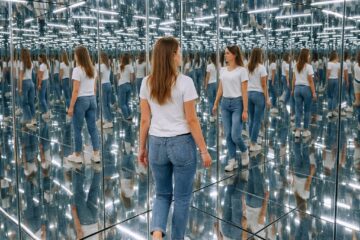
What we see is never neutral. We see through the lenses of our own stories—our time, place, assumptions, wounds, and hopes. Ordinary perception, as Allen Afterman suggests, is like looking out from inside a cube of mirrors: everything we see is refracted through ourselves. We can sit at the same table, witness the same moment, and walk away with entirely different experiences. How can that be? How can two truths occupy the same space and time?
I’ve been thinking about this a lot after reading Dark Matter, a novel that explores the idea of parallel lives—worlds that branch off each time we make a choice. The haunting refrain of if only I had or if only I hadn’t echoes something deeply human. We live in a world of sliding doors, constantly imagining other versions of ourselves and other outcomes. While we may not be traveling between universes, we do move daily between different inner worlds shaped by perception, memory, and meaning.
Kabbalah offers a powerful metaphor for understanding this. Daniel Matt, in The Essential Kabbalah, teaches that the Infinite (Ein Sof) emanates through ten sefirot—vessels of divine energy. The light itself does not change; only the vessels do. He invites us to imagine clear water flowing through differently colored containers. The water remains colorless, but appears red, green, or white depending on the vessel. Or imagine sunlight streaming through stained glass: the light is unchanged, yet our experience of it is shaped by the glass through which it passes.
So it is with us. Each of us carries that same primordial, eternal light. We are not different in essence—we are different in form. Our histories, personalities, bodies, and identities are vessels that shape how the light is expressed and perceived. Judgment and compassion, restraint and expansion, strength and tenderness—all emerge from the same source, refracted through different containers.
This teaching invites a radical shift in how we see one another. What if we learned to encounter people not only by their opinions, behaviors, or “masks,” but as vessels holding sacred light? Not masks as signs of inauthenticity, but as part of an ongoing process of revelation—what is shown now, what is still protected, what is waiting to emerge.
I feel profoundly grateful to be learning this alongside our students week after week. In our Wise Aging class, in conversations steeped in lived experience, and in our exploration of the Hebrew letters, wisdom doesn’t feel abstract—it feels earned, embodied, shared. The light feels visible there.
The question I’m holding is: how do we bring this awareness into the greater, messier world? How do we allow it to soften our certainty, widen our compassion, and help us see beyond our own mirrored walls?
I’m thrilled to explore these questions with partners in the coming weeks—teaching with Valley Beit Midrash on February 12, and with Judaism Your Way beginning February 17. These spaces offer opportunities to practice seeing differently, together.
I look forward to seeing the light that is in you—and to watching how it shines through our shared community.
Warmly,
Melanie