
by Dr. David Sanders
In late antiquity, Jewish mystics attempted to imagine the dimensions of God. In the mystical literature known as Shi’ur Komah (Measurements of the Divine), the distance between God’s eyes is described in hundreds of millions of parasangs, an ancient unit of measurement. At a human walking pace, travelling such a distance would take tens of thousands of years. The mystics were using measurements of almost unimaginable magnitude to convey something beyond human comprehension.
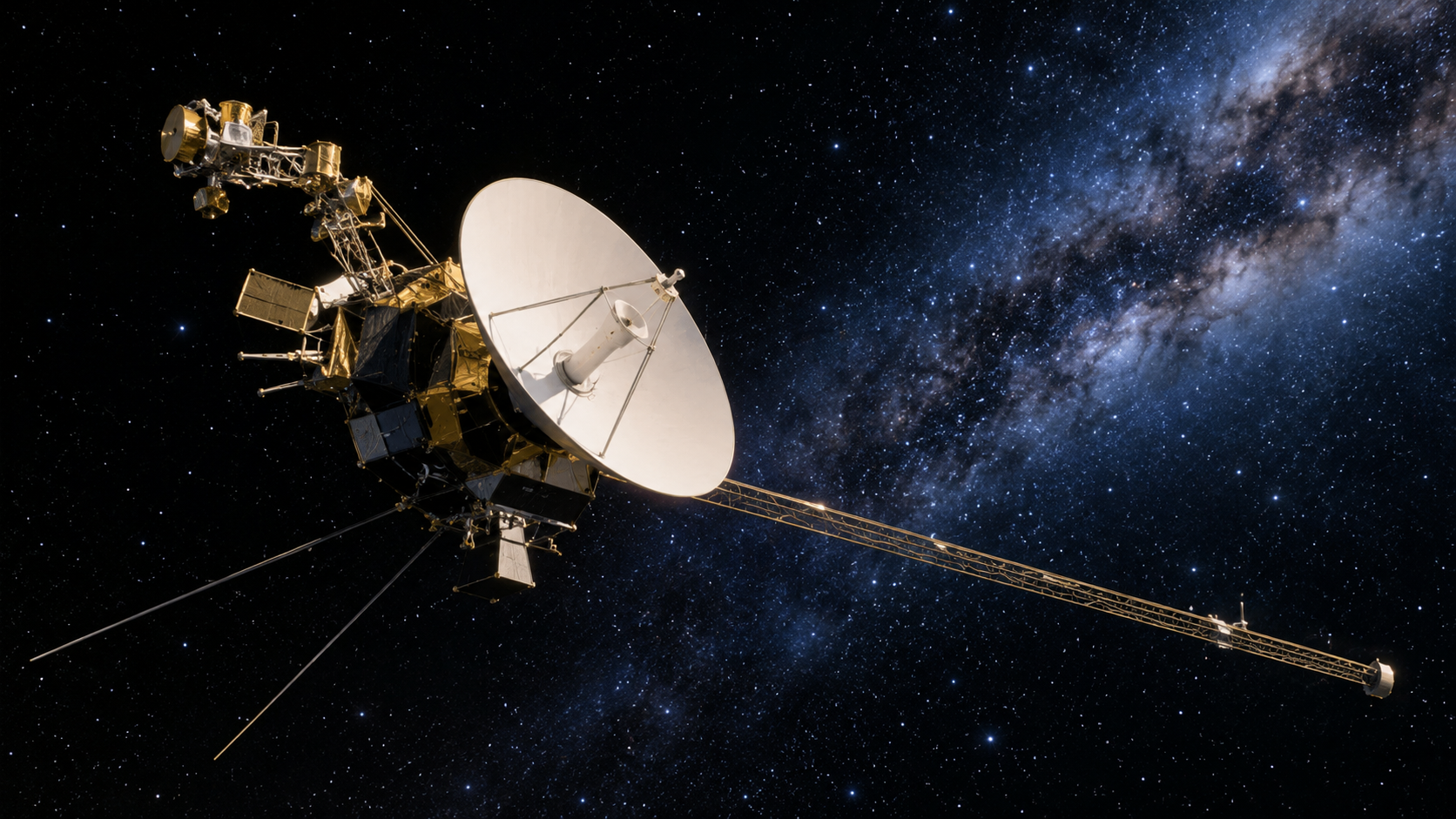
This month Voyager 1, the space probe launched nearly fifty years ago with a recording of Johnny B. Goode and other songs and sounds from planet earth, reached a distance of approximately one light-day from Earth. It has taken this spacecraft almost half a century to traverse the distance light travels in a single day. At its present speed, Voyager would require approximately 18,000 additional years to travel one light-year. It would reach the edge of the Milky Way galaxy in approximately five hundred and fifty million years. And our galaxy is but one of a hundred billion or more galaxies, The vastness of the observable (measurable) cosmos stretches across some 93 billion light-years.
What the ancient mystics imagined as the dimensions of God, modern astronomy reveals as a measure of the vastness of existence itself. Perhaps the ancient mystics were not simply imagining an enormous God. Perhaps they were attempting to express an intuition about the magnitude of reality that remains beyond our capacity to comprehend.
A rabbinic teaching declares, “God is the place of the world, but the world is not God’s place” and the Zohar teaches, “There is no place empty of Him.” (a meditation we repeat as a mantra in class, D’layt Atar Panuey Me-nay). What if we took these teachings one step further? What if there is no place empty of God because there is no place other than God? What if God is not a being who occupies existence, nor even a being who encompasses existence, but existence itself?
When we speak of God as Creator and the universe as creation, our very language suggests a separation between the two. We imagine a being who brings something other than itself into existence. But what if the capacity to create is inherent in existence itself? Energy manifests in matter. Stars form and die, creating the conditions for new worlds. Organic life emerges, evolves, and eventually becomes conscious of its own existence. Creation is not merely something that happened. It is an ongoing unfolding.
An opening section of the Zohar offers a radical suggestion to the meaning of the first three words of the Torah. Rather than “In the beginning God created,” it parses the Hebrew to read: “With beginning, Elohim (God) emerged.” God, in this reading, is not the subject of the sentence but its object. God is then not solely the origin of the unfolding; God can be also understood as the unfolding itself? The six days of creation would then describe the unfolding of existence itself — the emergence of light, matter, life and eventually beings capable of consciousness. The same existence that stretches across billions of light-years has, in at least one tiny corner of the cosmos, become aware of itself.
The mystics of Shi’ur Komah imagined the immeasurable distance between God’s eyes. Perhaps the more astonishing mystery is that existence has given rise to our eyes, through which we gaze into its immeasurable depths. As Voyager travels through the vastness of space, and as we peer ever deeper into the origins of our universe, we are not simply discovering the dimensions of God. We are participating in the unfolding of God. We are existence that has become aware of itself, capable of looking back upon its own beginnings and experiencing awe at what it is, what it has become and what it is becoming. It has taken billions of years for existence to grow eyes with which to look upon itself — and to marvel at what it sees.