

by Dr. David Sanders
Every so often we get to go back to the beginning, circle back to where it all started. More than two decades ago I sat around a dining room table, early morning on a Thursday, with four men, two who I knew and two who were new to me. Dr. Ryan Kramer had convened us without any particular agenda other than an invitation to explore Kabbalah. At the time there was no curriculum, so I offered to read with them Allen Afterman’s Kabbalah and Consciousness. Afterman was a poet, his writing dense and at times purposely impenetrable. I decided that a more accessible approach was necessary. Our introduction to Transformative Kabbalah is poetic as we rely on the metaphor of “a woman facing her sister” to illustrate that the essence of what we are studying is parallels, understanding the correspondences between seen and unseen reality. We highlight that the one and only context that the word Kabbalah appears in the Torah is in the construction of the Tabernacle—the place where the infinite, the unseen, manifests in the finite seen. The curtains that formed the container were held up by loops and as specified, these loops ran parallel to each other “as a woman faces her sister.”
This coming Saturday, Ryan Kramer, will celebrate his “second Bar Mitzvah” at age 83. Ryan asked if I would read from the Torah to honor him on this special occasion. It is the Torah portion which contains the reference to Kabbalah, the verse about the loops on the curtains running parallel to each other. As I read that verse it will close a number of loops for me. That Torah portion was my father’s Bar Mitzvah reading, the man who lovingly apprenticed me to chant the Torah and who promoted me at age 7 to read for the junior congregation at his synagogue. It is Ryan’s Bar Mitzvah reading, a man who served, along with Bob Loup, as a surrogate father for me upon my dad’s death shortly after I moved to Denver. Those are the seen loops, as a “son faces his father.”
The unseen loops will reveal themselves as they inevitably do. That is the task of pulling back the curtain, to see the invisible threads of the infinite that link us to sisters, brothers, parents, children, spouses and all those who become surrogates for the weaving of our connections whether they seem insignificant or touch us deeply.
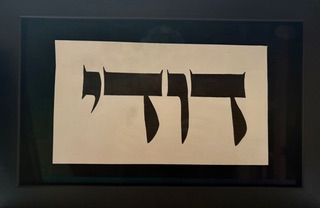
Ryan had one other request prior to his Bar Mitzvah. “Did I know,” he asked, “where he could find purplish-blue thread to twist into the fringes (Tzizit) of the prayer shawl (Talit) he will wear on this occasion?” I let him know that I had purchased some of that not easily attained dyed woolen threads in Israel decades ago and it would be my pleasure to gift it to him. Ryan was grateful and let me know that he had a gift for me. He asked to meet and handed me a framed art piece with the Hebrew word Dodi (pictured above) handwritten by a scribe.
As a singular word, Dodi means “beloved”. It conjures the poetry of the song of songs, “I am to my beloved and my beloved is to me.” The same purplish-blue thread twisted into fringes on the prayer shawl served as the material for the loops holding up the curtains. Thank you Ryan for revealing the parallels we have now studied for over twenty years as we celebrate your Bar Mitzvah, full circle.



1 Comment
Kelly · February 20, 2026 at 8:28 am
“That is the task of pulling back the curtain, to see the invisible threads.” I needed this right now. Thank you for sharing such a beautiful experience.