
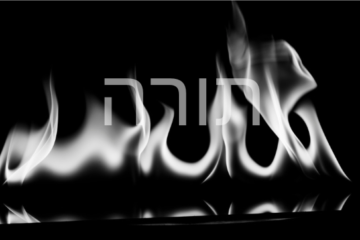

by David Sanders
There is an ancient teaching that the Torah was written “black fire on white fire.” While it is obvious that in order for writing to be discernible (as opposed to engraving) one needs a contrast such as black lettering on a white background (or white on black). If all that was being conveyed was the Divine origin of the word of Torah, then it would appear to have been sufficient to say that the Torah was written with black fire. The Kabbalists saw in the added “white fire” not just negative space. The white space, the gaps between or surrounding the black letters were of significance, pregnant with meaning. Centuries of mystical interpretation found way to the Hasidic master, Levi Yitzchak of Berdichev, who in the 18th century wrote about revealing the white letters of the Torah.
“It is known that the letters of the Torah have the aspect of inner lights which are revealed according to the order of the emanation of the worlds. And the boundary of the white that encompasses the letters possesses the aspect of the encompassing lights, which are not revealed but are found in a hiddenness, in the aspect of the encompassing light. From this we may understand that the white boundaries also possess the aspect of letters, but they are hidden letters, higher than the revealed letters.”
The Kabbalists made a point of highlighting that the Torah has neither vowels or punctuation which allows for a plasticity in interpretation and therefore suggested that the (black) letters could be rearranged to form different words (and gave examples of newly configured words which altered the meaning). What they didn’t address was what the white letters might convey.
Through our New Jewish Story Fellowship and courses we are exploring and discovering another dimension of the white fire which seems obvious but apparently has been obscured. Zachary Zimmermann (from JEWISHColorado), one of our Fellowship alums, shared his view of the white spaces as “unravelling the mysteries of the left-over stories, what was unsaid, learning from the spaces within the spaces.” The Torah text we have delved into for our “white fire” discovery is the story of Eve and Adam in the Garden of Eden. The black fire tells one story. What is the white fire story, what was left unsaid for us to feel into and to creatively probe? Should our curiosity not be engaged in a text which has not a single word of dialogue between the two protagonists, the main characters of the story?
From Milton’s romantic rhapsody in his Paradise Lost to Mark Twain’s satiric wit in his The Diaries of Adam and Eve, words are placed into the mouths of the humans in the Garden. It is for us to heed the call of the white fire and enliven this and other of our ancestral stories and reveal the light that is hidden inside.



One Response
… “the white boundaries also possess the aspect of letters, but they are hidden letters, higher than the revealed letters.” I’m just recently dipping my toe in the deep waters of Kabbalah, but this sure seems powerful to me. Thank you.