
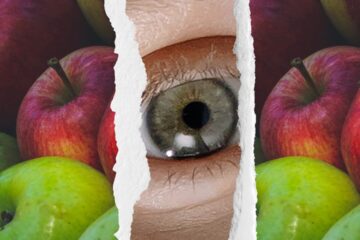

by Melanie Gruenwald
The concept of metaphor keeps showing up in my classes this month—and, also, in my own life.
Metaphor is how I make sense of the things that can’t be explained directly. It’s how I teach, how I learn, how I sit with both joy and grief. When we talk about the Divine, the sefirot, or the levels of the soul—we are reaching beyond ourselves. We can’t fully know these mysteries, so we give them names and images that anchor them in our experience.
I often remind students: we live through metaphor. Grief may feel like waves of the ocean to one person, while for someone who has never stood at a shoreline, it might feel like shifting desert sands. Neither metaphor is “correct”—each is simply a doorway into something too vast for words.
How metaphors sneak into everyday life
Sometimes I notice how much metaphor shapes my daily language. I “carry the weight of the world,” “burn the candle at both ends,” and (when I’m really overcommitted) “juggle too many balls in the air.” The funny thing is—I am a terrible juggler. If my life really depended on juggling, everything would come crashing down. But as a metaphor, it lands.
The Kabbalistic dimension
Kabbalah tells us that Binah—understanding—is where metaphor lives. Within Binah there are said to be 50 Gates of Understanding, each gate opening onto a new depth of awareness. For me, this teaching is a reminder that we all learn, and teach, in layers. What makes sense to an individual today may unfold differently tomorrow. What speaks to me in a concept at 25 reveals something else at 45.
I’ve experienced this myself: reading a passage of text or hearing a melody I thought I knew—and suddenly it feels brand new. The metaphor shifts. The gate opens a little wider. That is the gift of Binah: it reminds us that understanding is not static. It is alive, changing as we change.
Letting go of old metaphors
Some metaphors outlive their usefulness. I used to describe my schedule as a “tightrope walk”—but eventually, I realized I was more like a person on a trampoline. I wasn’t walking a straight line; I was bouncing, falling, laughing, sometimes losing balance, sometimes soaring higher than I thought possible.
And that’s the beauty: metaphors don’t have to be permanent. They can be revised, retired, or reimagined.
An invitation for the new year
As we begin the Jewish New Year, my hope for all of us is that we soften into this process. That we give ourselves permission to let go of metaphors that no longer fit—like shoes we’ve outgrown—and to embrace new ones that help us see more clearly.
May we listen to songs with new ears, see the world with new eyes, and keep stepping through the gates of understanding—together.



3 Responses
Today I have learned something that I never thought of. I stay at Bina Street at our location and when I write my Street Name I write it as Binah Street all the time. To my surprise today it means that our street Binah Street and its residents we are Understanding because whenever there is chaos in our area the people of Binah Street are the ones who come with solutions. I am grateful
Recently when I find a song in my head that won’t go away, I try to examine what those words really mean to me personally. It’s amazing how something so familiar can become so enlightening when you see it from a different point of view or different time in your life.
I really enjoyed reading about metaphors and freeing oneself to change or tweak our old favorites to accommodate our changing lives. Thank you.
I really liked this quote, “Metaphor lives a secret life all around us. We utter about 6 metaphors a minute.
~ James Geary. I appreciate understanding Binah better.